Template previews
Free Home Equity Loan Calculator Spreadsheet Template
Understanding your home equity is an important step before applying for a home equity loan, second mortgage, or any loan that uses your property as collateral. This spreadsheet template helps homeowners estimate how much they may be able to borrow, calculate loan payments, review total interest, compare repayment scenarios, and project future home equity over time.
The workbook gives you a structured way to evaluate borrowing power and repayment before making a financial decision. You can enter your home value, loan balances, interest rates, payment terms, extra payments, tax bracket, and appreciation assumptions to create a practical home equity analysis.
The result is a clear view of estimated loan amount, payment per period, payoff timeline, interest cost, outstanding balance, potential interest savings, tax-related estimates, and projected pre-tax home equity.
What Is a Home Equity Loan Calculator Spreadsheet?
A home equity loan calculator spreadsheet is a downloadable Excel-style tool that helps homeowners estimate the financial details of borrowing against the equity in their home. Home equity is generally the difference between the home current value and the total amount still owed on loans secured by the property.
This template works as both a home equity loan payment calculator and a broader equity planning spreadsheet.
- How much money you may be able to borrow
- Potential home equity loan amount
- Monthly or periodic loan payments
- Total interest paid over the loan term
- Remaining balance after a selected number of payments
- Principal and interest breakdown
- Impact of extra monthly or annual payments
- Potential interest savings from prepayments
- Estimated tax return impact based on a tax bracket
- Future home equity based on appreciation and repayment
What Is Included in This Free Home Equity Loan Calculator Template?
The workbook includes multiple built-in sections designed to help users understand both borrowing capacity and repayment structure. It combines qualification, payment calculation, amortization, prepayment planning, tax estimates, and future equity forecasting.
- Qualification calculator
- Potential loan amount estimate
- Loan-to-value ratio input
- Existing mortgage and lien balance tracking
- Home equity loan payment calculator
- Loan amount, interest rate, loan term, and payment frequency inputs
- Extra payment and annual prepayment inputs
- Loan summary section
- Balance due at a specified payment period
- Tax deduction estimate section
- Amortization-style payment schedule
- Interest vs. principal chart
- Home equity projection calculator
- Two-loan equity modeling
- Future equity summary table
Estimate How Much You May Be Able to Borrow
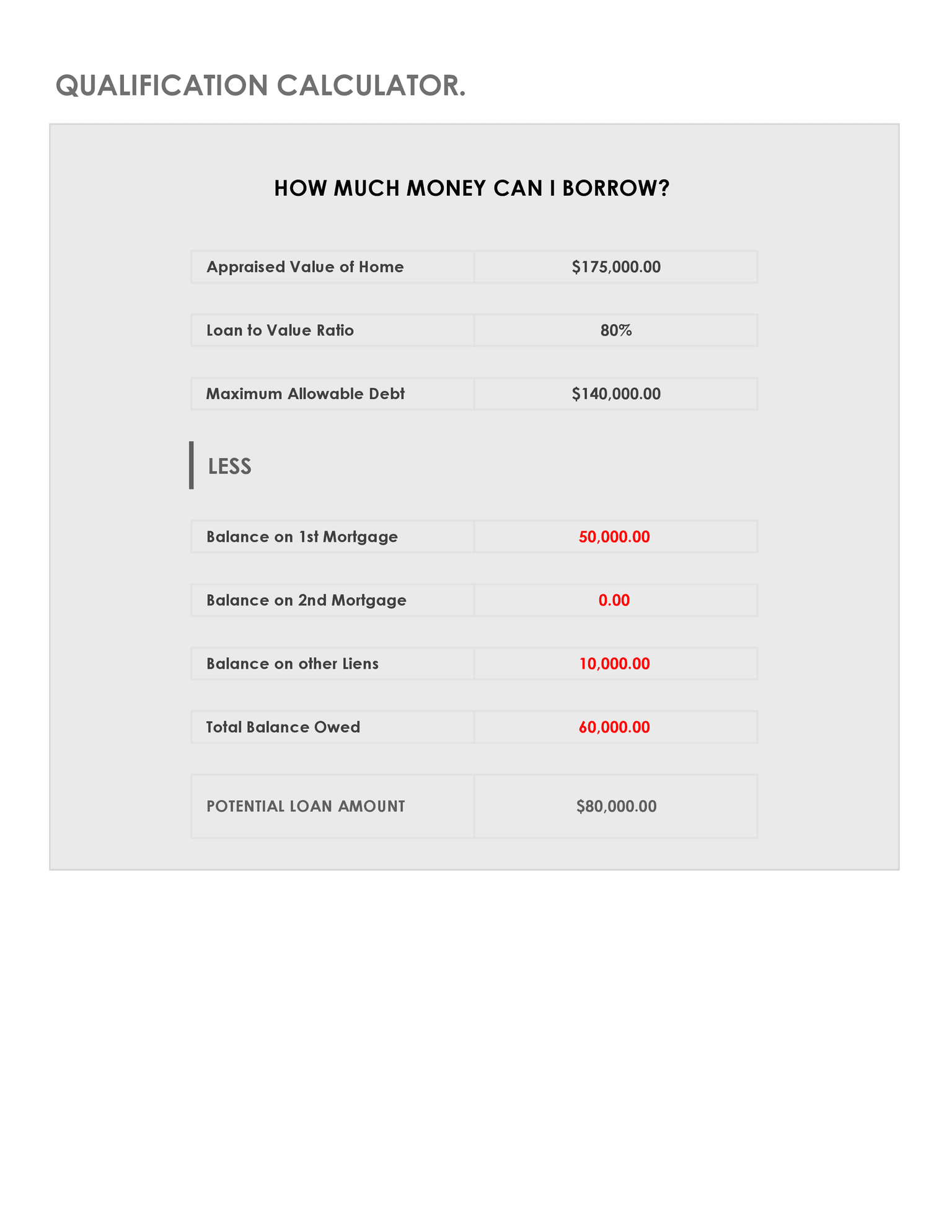
One of the most useful parts of this spreadsheet is the Qualification Calculator, which helps estimate potential loan amount based on appraised value, lender loan-to-value ratio, and existing debt secured by the home.
Appraised Value of Home
Enter the estimated current market value or appraised value of your property. This is the foundation for calculating potential borrowing capacity.
Loan-to-Value Ratio
Enter the lender LTV limit. If a lender allows 80% LTV, the maximum allowable debt is calculated as 80% of the home appraised value.
Maximum Allowable Debt
The spreadsheet calculates maximum allowable debt by multiplying the appraised home value by the loan-to-value ratio.
Existing Mortgage and Liens
Enter balances for the first mortgage, second mortgage, and other liens. These are subtracted from maximum allowable debt.
Potential Loan Amount
After existing balances are considered, the spreadsheet displays the estimated potential home equity loan amount.
Calculate Home Equity Loan Payments
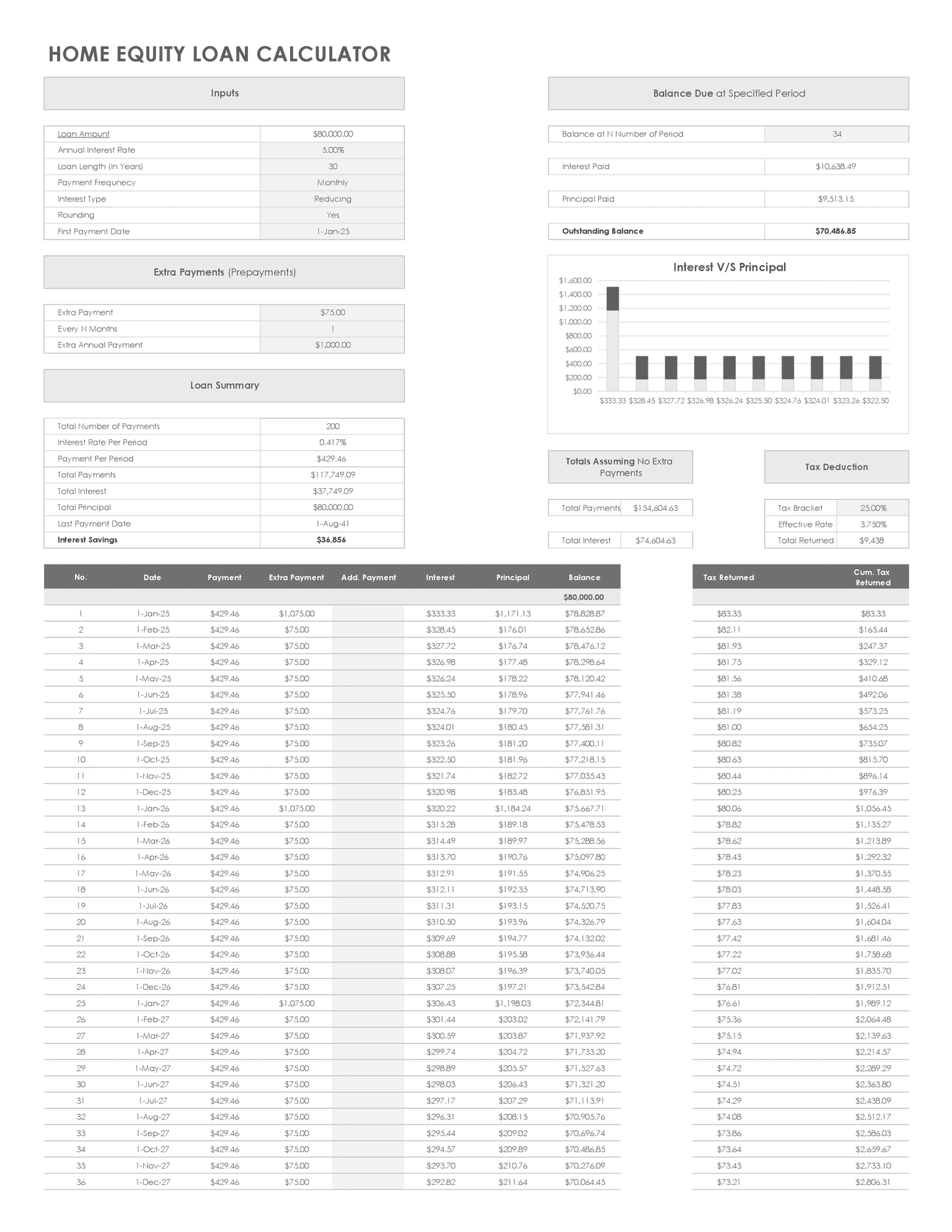
The main loan calculator sheet estimates periodic payments based on loan amount, interest rate, loan length, payment frequency, and first payment date. The loan amount can be pulled from the qualification calculator so the borrowing estimate connects directly to repayment planning.
- Loan amount
- Annual interest rate
- Loan length
- Payment frequency
- Interest type
- Rounding option
- First payment date
Review a Detailed Loan Summary
After loan details are entered, the spreadsheet generates a loan summary with the key numbers needed to evaluate the loan. This helps users understand both the payment amount and the full repayment picture.
This is valuable when comparing offers because a lower payment does not always mean a lower total cost. A longer loan term may reduce monthly payments but increase total interest, while a shorter term may increase the payment but reduce long-term borrowing costs.
- Total number of payments
- Interest rate per period
- Payment per period
- Total payments
- Total interest
- Total principal
- Last payment date
- Interest savings
Track Extra Payments and Prepayments
The built-in Extra Payments section lets homeowners test how additional payments may affect loan balance, total interest, and payoff timeline. Users can enter an extra payment amount, frequency of extra payments, and extra annual payment amount.
The template also includes a Totals Assuming No Extra Payments section, making it easier to compare normal repayment against accelerated repayment.
- Pay off a home equity loan faster
- Reduce total interest paid
- Compare normal repayment vs. accelerated repayment
- Plan annual lump-sum prepayments
- Understand how extra payments affect outstanding balance
Check the Balance Due at a Specific Period
The Balance Due at Specified Period section lets users review the loan position at a specific payment number. This is helpful for refinancing analysis, early payoff planning, selling a home in the future, budget forecasting, and understanding loan progress over time.
- Balance at a selected number of periods
- Interest paid up to that period
- Principal paid up to that period
- Outstanding balance at that point
Built-In Tax Deduction Estimate
The spreadsheet includes a tax deduction estimate section based on the user tax bracket. This can help users create a rough estimate of potential tax-related impact connected to interest payments.
Tax rules vary by location, loan purpose, filing status, and current law, so this section should be treated as an estimate only and not as tax advice.
- Tax bracket
- Effective rate
- Total returned
- Tax returned per period
- Cumulative tax returned
View a Full Amortization-Style Payment Schedule
The template includes a detailed payment schedule that shows how the loan balance changes over time. The schedule helps users understand how each payment is divided between interest and principal and how extra payments affect the balance.
- Payment number
- Date
- Payment
- Extra payment
- Additional payment
- Interest
- Principal
- Balance
- Tax returned
- Cumulative tax returned
Visual Interest vs. Principal Chart
The Interest vs. Principal chart gives a quick visual view of how payments are divided. Many borrowers find repayment patterns easier to understand visually than by reading numbers only.
- How much of the payment goes toward interest
- How much goes toward principal
- How balance reduction changes over time
- How repayment accelerates as interest declines
Estimate Future Home Equity Over Time
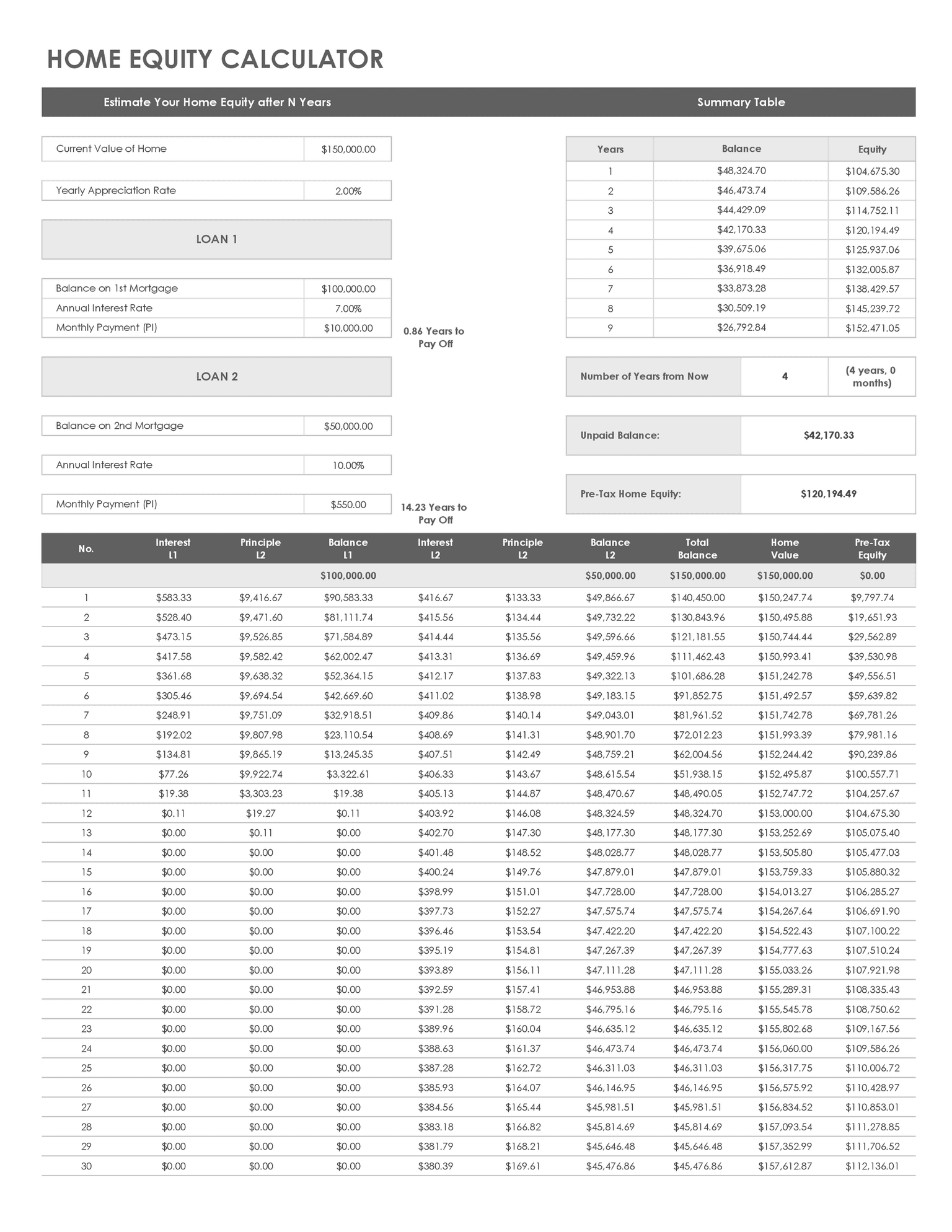
The workbook includes a dedicated Home Equity Calculator section that estimates future equity based on home value, appreciation rate, and mortgage balances. It can model both a first mortgage and a second mortgage, then compare total balance owed with projected home value.
The spreadsheet also supports a negative appreciation rate, allowing users to model a potential decline in home value.
- Current value of home
- Yearly appreciation rate
- Balance on first mortgage
- Annual interest rate for first mortgage
- Monthly payment for first mortgage
- Balance on second mortgage
- Annual interest rate for second mortgage
- Monthly payment for second mortgage
- Future home value and pre-tax equity
Summary Table for Future Equity
The home equity projection section includes a summary table showing estimated balance and equity over future years. Instead of analyzing every monthly line item, users can review an annual snapshot of projected loan balance and estimated equity.
- What might my home equity be in 1 year?
- What could my equity look like in 5 years?
- How much equity might I have after paying down my loans?
- How does home appreciation affect my equity?
- How do first and second mortgage balances affect my equity position?
Why Use a Spreadsheet Instead of a Basic Online Calculator?
Online calculators can be useful for quick estimates, but a spreadsheet gives users more control. With a downloadable Home Equity Loan Calculator spreadsheet, users can save assumptions, adjust scenarios, compare loan terms, and keep a reusable planning file.
- Save multiple loan scenarios
- Adjust loan amount, interest rate, and loan term
- Test extra payment strategies
- Estimate total interest and total payments
- Review amortization details
- Track future balances
- Estimate home equity over time
- Model home appreciation or decline
- Compare repayment with and without extra payments
- Keep calculations private and reusable
Who Should Use This Home Equity Loan Calculator Template?
Homeowners Considering a Home Equity Loan
Homeowners can estimate how much they may be able to borrow and what repayment may look like.
Homeowners Planning Renovations
The spreadsheet can help estimate loan payments and long-term repayment costs before using equity to fund improvements.
Borrowers Comparing Loan Offers
Users can compare interest rates, loan terms, payment amounts, and total interest to better understand loan options.
People Planning Debt Consolidation
Homeowners can estimate payments and evaluate whether the loan structure fits their budget.
Real Estate and Mortgage Professionals
Professionals can use the calculator as an educational tool to explain equity, LTV, repayment schedules, and borrowing power.
Homeowners Planning to Sell or Refinance
The future equity calculator can help estimate possible equity at a future date.
Key Benefits of This Free Home Equity Calculator Spreadsheet
- Estimates borrowing power
- Calculates loan payments
- Shows total interest
- Tracks extra payments
- Estimates interest savings
- Includes an amortization schedule
- Provides tax-related estimates
- Projects future home equity
- Supports two-loan modeling
- Beginner-friendly and reusable
How to Use the Home Equity Loan Calculator Spreadsheet
Start with the qualification calculator. Enter your home appraised value, lender loan-to-value ratio, and existing mortgage or lien balances. The spreadsheet will estimate your potential loan amount.
Next, move to the loan calculator section. Enter loan amount, annual interest rate, loan term, payment frequency, interest type, rounding preference, and first payment date. The calculator will generate payment details, total interest, total payments, and a loan schedule.
Then enter any extra payments or annual prepayments you plan to make. Finally, use the home equity projection sheet to estimate how equity may change over time based on appreciation, first mortgage details, and second mortgage details.
Frequently Asked Questions
What is a Home Equity Loan Calculator spreadsheet?
A Home Equity Loan Calculator spreadsheet is a downloadable tool that helps homeowners estimate available equity, potential loan amount, payments, interest costs, repayment schedule, and future home equity.
Is this home equity loan calculator template free?
Yes. This template is designed as a free downloadable spreadsheet for homeowners, borrowers, and financial planners who want to estimate home equity loan details.
What information do I need to use the calculator?
You need your home estimated value, lender loan-to-value ratio, current mortgage balances, loan amount, interest rate, loan term, payment frequency, first payment date, and any planned extra payments.
Can this calculator estimate how much I can borrow?
Yes. The qualification calculator estimates potential borrowing capacity using the appraised value of the home, loan-to-value ratio, and existing mortgage or lien balances.
Does the spreadsheet calculate home equity loan payments?
Yes. The loan calculator estimates payment per period based on loan amount, annual interest rate, loan length, payment frequency, and selected settings.
Does the template include an amortization schedule?
Yes. The spreadsheet includes a detailed payment schedule with payment number, date, payment, extra payment, interest, principal, balance, tax returned, and cumulative tax returned.
Can I test extra payments?
Yes. The template includes extra payment and annual prepayment inputs so users can estimate how additional payments may reduce interest and affect payoff timing.
Does the calculator estimate future home equity?
Yes. The home equity projection sheet estimates future home value, unpaid loan balance, and pre-tax equity based on appreciation and loan repayment assumptions.
Can I use this for a second mortgage?
Yes. The template includes first mortgage and second mortgage fields, making it useful for homeowners who want to model multiple property-secured loans.
Does the tax deduction section provide tax advice?
No. The tax deduction section is for estimation only. Tax rules vary, and users should consult a qualified tax professional before relying on any tax-related estimate.
Is this spreadsheet suitable for beginners?
Yes. The template is organized into clear sections with simple inputs and automatic calculations, making it easy for beginners to use.
Can this calculator replace professional loan advice?
No. This spreadsheet is an estimation and planning tool. Actual loan terms, lender requirements, tax treatment, interest rates, fees, and approval decisions may vary.